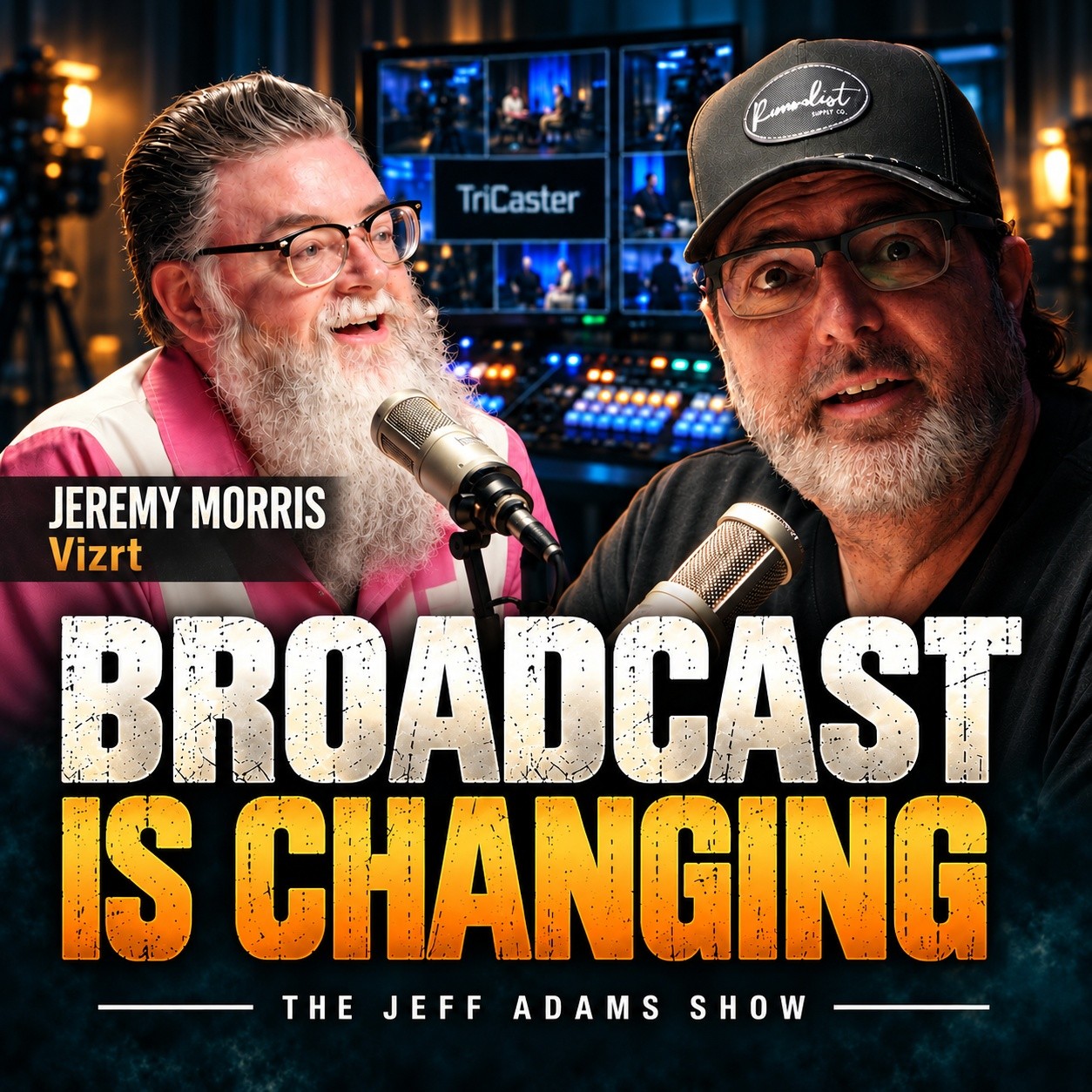
TriCaster, AI & the Future of Broadcasting with Jeremy Morris of Vizrt
October 3, 2026 · 1:03:39 · Hosted by Jeff Adams
About this episode
Broadcasting is changing—but technology is only part of the story.
Jeremy Morris of Vizrt, the company behind TriCaster, joins Jeff Adams for a conversation about live production, artificial intelligence, and the relationships that keep the broadcast industry moving.
Jeremy shares his journey from discovering the Video Toaster in high school to working for Vizrt. Together, they explore how TriCaster supports live production, how AI is helping streamline workflows, and how broadcasters are reaching audiences beyond traditional television.
You’ll also hear about:
• Why reliable equipment and customer support matter when you’re live
• The balance between automation and the human side of production
• What “broadcast quality” really means—and why expensive gear isn’t always the answer
• Building trust with clients, manufacturers, and production teams
• Advice for anyone pursuing a career in broadcasting, audio, or video production
Recorded at Blue Jay Recording Studios for The Jeff Adams Show.
Follow The Jeff Adams Show for more conversations with creatives, entrepreneurs, and industry professionals.
Full transcript
Read the transcript
Welcome to the Jeff Adams show. It's been a very long time. This is like the third resurrection of this podcast live stream radio program. It's been a lot of things, but now we're here. I'm in my 50s. And once again, bringing this back from the dead. But today I'm excited. I have a buddy of mine, Jeremy, and I'm going to ask him some questions and, uh, it was see if he can answer them. Cause the first one I'm trying to Jeremy and thanks for being here today. Of course. And, uh, he down here vacationing here in central Florida. And, uh, he said, Hey, I can swing by. Cause I did a big announcement on social media. It's not big, but I just said, Hey, I'm looking for guests. And Jeremy goes, Hey, I'm in, I'm down. I'm like, well, come on in. Yeah. So, uh, How are you enjoying Central Florida? It's hot. It's hot. It's always hot. I know. But you're in Georgia too. It's the same thing. We don't have the humidity. I guess that's not as bad. Not as bad. What I wanted to ask you, I mean, your background, tell everybody who you work for. So I'm Jeremy Morris. I work with VizRT, something we talked about beforehand. How do you actually say the name of the company? Maker of fine broadcast production gear. And that's what I wanted to ask you. Yeah. And I was like thinking, I was like, how did I connect with you? Was it through NAB Live when I was doing NAB Live? Or was it through like Stephen Haywood when I was doing like the tech bus stuff at Broadcast Now? I don't remember, but it was like several things at once, I think. And it kind of like worlds collide. It was like, oh, and then became the Facebook conversations and stuff. And then I know there were some other things that were going on through some of your other ventures and whatnot. We talked about some things and then became... Yeah, when you'd show up at shows at Infocomm and NAV and whatnot and do little mini tours and things like that. So it's been going on for a few years. Yeah, yeah. It's awesome. I was trying to think, was it an NAV live thing? What was it? I don't know because a lot of people don't remember that stuff with Stephen Haywood because he took all that stuff down. But we did that show broadcast now. We were doing a full live stream talking about broadcasting gear before it was even a thing. Stephen Haywood was ahead of his time. I think it was after that. But yeah, I knew of it. So yeah, so I kind of knew of you and whatnot and kind of connected and then hit it off. And so now we're friends. Yeah, I'm glad. It's crazy how this industry works sometimes. Yeah, so your backstory, the whole premise of this program is to really find people with interesting stories, what they're doing with their lives. And a lot of it's, we talked to a lot of small businesses, entrepreneurs, but- a lot of creatives really focused a lot of creatives and you're a creative guy. Um, and what led you down the path? I mean, obviously you have like a music background. You were blown away by the blue J recording studios here. And by the way, we're at blue J recording studios today, uh, recording this podcast, beautiful place. You want a podcast? Very well done. I was, yeah. And it's phenomenal. But so tell us a little about your background and how you got to where you're at now. So I started in high school on a video toaster. Yeah. I had a, They had a TV studio in my high school in central Indiana. I walked into that studio at the age of 15, never left. Yeah. And now entire career coming full circle to actually work for the company that made that product way back when has been very cool. And so being part of that through the entire life cycle, not just of that product where it came from the video toaster and the VT series and the TriCaster, but also what avenue it fed into. Yeah. the different verticals. And then when I went to college and then got into the dealer integrator world, still being part of that and then seeing where that product fit and then becoming, you know, one of the largest dealers of the TriCaster in the nation. Now to actually work for that company was, you know, the entire career coming full circle has been a blessing. It's been very cool. And then seeing the outreach and the minor celebrity status in this industry, which is very, very weird. Like I gave four legit autographs at NAB this year. Wow, dude. That's not normal. You're the guy, man. You're the guy. As I get older, my brain doesn't work very much anymore. Man. Nelson. Philip Nelson. He was there for a while. He was like how I met him. I bought two talk shows from him back in the day, directly when they first came out, when I had the other studio in Lakeland. That's somebody else who has really expanded You know, because now he's got his own company. But just he's got fingers in everything and type of production. And it's really cool seeing some of the stuff that he does completely independent. I mean, he's got his music career going. Yeah. So he does so many different cool things. But how those worlds can come back together. Because a lot of times, especially in this type of industry, it's incredibly niche. And you know one thing, you do one thing very well, and that's it. Yeah. And you don't deviate. You don't branch out anything else. Right. So you'll see a lot of ebbs and flows, but as technology moves, some of these companies get really, really big and then disappear. You were like, where'd that company go? What happened? Right. Well, that's because they were so niche. They did one thing so very, very well that they couldn't adapt to the change. Yeah. So you have to have the capability to talk a wide variety of different applications, different industries, different verticals, different workflows. That's what's been really exciting for my career because I've been on both sides of it as someone who did all the design and installation and training of all these systems. To then selling that product. It was, hey, I know how this fits. Right. Plus, I know what this other piece of gear talks to because I've had to do the entire installation. Yeah. By walking upstairs to that, I was like, uh-huh, I've built the studios. I've built the room within the rooms. You know, I've done the sand traps and all that stuff into recording studios. So having that background, that knowledge and understanding, that helps by solving the pain points for the clients. Yeah. And somebody comes like, hey, I just need this to do one thing. It's like, well, I can do one thing, but also do 400 other things. Yeah. Yeah, but isn't that so cool? You're able to do your God-given gift. I mean, I think that's so rad. And rare, yeah, and definitely humbling a lot of times, yeah. You get to wake up with a smile on your face. You actually enjoy going to work? It's not my work. It's my life, and much to my wife's chagrin sometimes. Yeah, you travel a lot. I mean, we're friends on social media, and you're always on a plane going somewhere. And I said, where is he going this week? Yeah. we were on the way over here, it was on another call talking about where, where we're going to end up next. And so there's several more trips still coming. Yeah. And I, you know, that's the thing I, you know, you always, everybody thinks that, and you can chime in on this too. It's like when you travel for work or you're traveling, I'd be like, Oh, what a life that is, you know? And you become like a road dog, I call them road dogs. You live on the road. And everyone's like, Oh, that's gotta be so cool that you you're on the road. But half the time you're on a, you know, your trade room floor, and you're exhausted at the end of the day. So you pretty much get your food and go to sleep and get back up. Yeah. Oh, yeah, it's great spending two weeks in Vegas. No. You know how many times I've been to Vegas, Jeremy, that I've been to Vegas so many times at NAB Live and other projects, and I have never ventured out of the strip. I've never went out to the desert. I've never went out to see Hoover Dam. Yeah. And I just want to go out there, you know, we like to shoot content and film. And I'm just like, I want to just go out in the desert, do a drone shot, driving a car or something. And I'm always exhausted. I can't do it. When I was a dealer, we would go out and then, yeah, you had dealer meetings with different manufacturers and you had, so we did have the time to do stuff like that. Yeah. Now I'm on the manufacturer side. It's like all day, every day. Cause I'm there to build the show and then through the entire show. And then the way NAB works, we have a distributor that has a pre NAB event. Yeah. So technically I have two shows that I have to do. Yeah. You know, the pre-show and then NAB. So it's long and you just don't have the time to do anything else really. And even in the Infocom days, it used to be cool because you would have those big dealer parties. I mean, this is, you know, 10, 15 years ago. Yeah. You know, so I got to see, you know, Beatles love. I got to see. Oh, man. Because that's how dealers treated or were treated by manufacturers. A lot of that's gone away over the years. especially post-COVID, it's just like no one really has the time or energy to do that, and how they've changed the schedules of the shows. That's also made a big impact on your downtime, supposedly, because you would have a couple days here and there, especially during NAB, where you could kind of do some stuff like that. You had the weekends for all the dealer meetings, and then the show started on Monday. Now the show starts on Sunday, it blows everything up. It just makes everything a mess. And same with Infocomm. It's very difficult to get it. I think we try to do go to Fremont street or do something, at least one, you know, we do Korean barbecue as a group, you know, just something, some sort of thing, you know, commodity. Cause you're there 14, 15, 16, 18 hours a day. Sometimes, uh, one year that did happen, um, setting up the show. There were some always gremlins and you pay for power and you pay for all this. Oh, the internet. Gosh, it's just, uh, we had there was one, one year, um, power started getting tripped in like the section of the floor, uh, You would see booths start going off randomly because they couldn't figure out what was tripping different circuits. And so that made things a nightmare because you've got a lot of expensive gear and all of a sudden power cuts off. It's like, wait, what just happened? And no one knows. It takes 45 minutes to figure out. But they still want you to pay a full amount for their. Right. You're paying for all that. Yeah, we're paying for you to fix this, to make this work. You know what gives. And no discounts. No discounts. Even when they screw it up. Right. So that you have all that lead. So people don't realize when you have all that going into building out a show booth, then show opens, show starts. And so, yeah, there's a whole lot of extra work that goes into it. So, yes, you are exhausted. Oh, man. I. I remember it's a, it's a disciplined lifestyle and what you do. Cause I remember I came out of the music industry. So our hours are a little bit different. We did the shows at night and then. Everybody, everybody went to bed at, you know, 3am and got up at, but when I did the NAB live contract, uh, I think I had like a 7 a.m. Call time. And then after that, I had to go do floor stuff too. So I had my set, people I talked to for two hours and I had to go on the floor. So I remember one year, someone goes, oh man, you know, and everybody's like going out. I'm like, and then if you're not staying hydrated, that desert air makes your throat dry. Oh yeah, it dries you out so fast. And I was working, I was doing a work in Spreaker booth at the time. I was doing the Jeff, they wanted me to do the Jeff Adams show live with Spreaker. So I was at their booth and, My voice just completely went out. And then that same night, everybody goes, hey, man, why don't you guys go out with these guys with YouTube? Oh, come on, man. It's good. You can build. And I'm like, all right, cool. So I stayed up until like 2 a.m. And then I got up, and that was the worst day of my life. And I said, never again. And since then, when I would do things like that, I'm disciplined. I don't go out. I go eat. If I have a call time in the morning, I'm in bed by 8, 9 o'clock because– You know, it takes a lot. You're just talking all day long. And the time zone difference, it never fails. I'm always out there. And I'm an East Coast guy, so West Coast. Yeah. And you still have those clients that still want to call you at 9 a.m. Their time, well, it's 6 a.m. in Vegas. And so now I'm– I was like, hey, I've got to be on the show floor in an hour, and you woke me up an hour early. You know, I have to deal with something. I have my out-of-office. It's on there for a reason. But then I did, you know, I think it was like I was doing more– on camera stuff. And then I think for, I think it was like, I was still, I had a couple, a live stream contracts I was doing shows for, uh, that I was getting paid to do. And then I was like, man, this is, everybody wanted to do it. So when I was doing it, it was like a thing of people just throwing jobs at me left and right. And then the creator economy got really big and everybody's like, well, I can do it. And there was probably hundreds of people better than me doing it anyway. So they took all the work. So I said, well, let me get behind the scenes and start developing, you know, um, things for these companies. So I, With one, I'll say, and I'm not going to say the name, but I don't know if you know this or not. I was going through a divorce, and I was like, man, I've got to find stability because I just left the music industry. And I had the NAB contract, which you only get paid to do that when you're there. So I said, I need to maneuver. And so I went to work for a company in Slovakia, and they flew me out. And I got to tell you, that was, I went out by myself, traveled all the way out there. And I got, it was just awkward. I guess they had some kind of an investment firm that they were working with. And then there was all this, you know, there was tension between the CFO and the CEO. And, you know, they, I show up to training. It's early morning. I'm like jet lagged. And they hired some guy in Canada and another guy from the United States. I'm sitting there and there's like this homemade vodka in these bottles. And I'm like sitting there. He goes, what do you have tradition here? He goes, we salute for new beginnings. And so they had two bottles there. And guess what we had to do? I think it was like eight o'clock in the morning. We had to go through all, both of those bottles. And I was like toast. I mean, I, you know, back then I could hold my liquor. But I always like toast. Yeah. You weren't expecting that early in the morning. That's not a, yeah. And so anyways, it was weird. And then we went to a, they took us out and then the CFO goes, Jeff, come here, come here. Say if the CEO no longer here and do you have a problem answering to me? And I'm like, I was getting pulled back and forth. It's like this, it was like a movie. And I'm like, it's like Slovakia and all this stuff's going on. So, Anyways. And you didn't know if they were messing with you because you're, you know, from the US. Yeah. And they hired me to be their brand ambassador. Okay. And so Jeremy, and I'm not saying the name, so, you know, people know that you can figure it out, but they, the whole thing about a brand ambassador, you got to have a piece of gear. So I was thinking, I was going out there, I was coming back with a piece of gear. Like, no, no, no, no. We'll ship one to you. So yet they're paying me. I can't do anything because I don't have a piece of gear to showcase what it does. So finally I get it. And then I think I get it a day and, they hit me up and go, no, no, no. Uh, you need to do all your videos. I said, I just got the piece of the gear. He goes, well, we need to do the video. You need to ship the unit to Ohio. Uh, cause he's flying. And I was like, what the heck? And I said, you know what guys? I said, I'm out. I mean, I'm always, it was already stressing, but, uh, and then I found out like years later, I was at an AB live and they go, yeah, he used to work for this company that I'm like, yeah. He goes, you know, they were funded by the Russian mafia. Right. And I'm like, What? That makes sense. What? I got even shot and killed in Slovakia and no one would have it unknown. But that was, it was a good, it was a good movie because through that I worked with, you know, coming out of Paris and then, you know, you know, obviously I did stuff with broadcast picks and then we created this whole thing called radio picks. We were launching that and then bottom fell out, COVID hit and, you know, they were great. They paid me for a year, but everything went, silent. And I was, and I was working on a radio station too, the time doing a talk radio program with somebody. And it was great, but that world that you live and breathe, it's, it's a whole different, people don't understand like the manufacturing world and the broadcasting. It's just a whole different world than anything else. Cause I, yeah. And very incestuous. Yeah. Everybody knows everybody. Everybody's worked with everybody. People get married, divorced, whatever, all in the same companies. That's also entertaining sometimes. It's like, wait a minute, you're married to so-and-so and you work for this. Okay. How you make that work at home, I have no idea. But yeah, I was like, so I know Russell, you know, for broadcast specs, you know, you know, a lot of those guys. And it does become, you do have that families, even though there is a lot of competitive nature. Yeah. But most people still kind of keep things above board and we all know we're in this together. Right. And so that's been my whole thing because I was on the dealer side for 18 years. Yeah. And so I knew how to play the manufacturers against each other. It's like, now I'm on this side of the fence. Yeah. Like, okay. Yeah. I know the tricks. I know what you're trying to pull, but I'm also friends with everybody because I was a dealer for them for so long. Right. So the industry connections, the industry family is massive. Yeah. And you've got those connections. And a lot of times you'll see, you know, people that'll hop from company to company to company. You know, I had a boss that always said, you know, the name stays the same. It's just the badge changes on the shirt. Right. You still have the same person. You still have the same interaction. And it's about the relationship more than anything. Yeah, absolutely. And I've said that to a lot of people and have to deal with a lot of people that have come in through this industry thinking they know better because they came from software. They came from some other thing because they were high enough up. They're like, oh, you got the stature because you ran this type of company. You made this many millions. Now you're going to be in this industry. It's like, it's about the relationship. Always. You could have the best tech in the world, but if you're an a-hole to somebody, no one's going to buy your stuff. Right, right. Right. And we've had a few people learn that lesson the hard way. And it's like, I hate to say I told you so, but. Yeah. Again, it's the relationship because your livelihood is built on a product that is affecting someone else's livelihood. Yeah. On the day-to-day operation. Yeah. And I think that's also where I've kind of hit a nerve with a lot of people and why I get so many. And that's why I've become that little mini celebrity thing, which is still a little uncomfortable for me being, I'm the extroverted engineer. I stare at your shoes, not my own. Yeah. I use that joke a lot and you can always tell what kind of room it is. And if it goes flat, I know it's like, okay, cause I'm a full of introverts and they're not, they're laughing on the inside because they don't want to talk about outside. But it is that relationship status, my stuff, what I'm trying to pitch and also the trust that you have in me, because I'm the one hawking this has to work for you because you got to make your livelihood based on it. And if it falls flat, not only are you now forced with, Hey, This is my job. This is my life. This product doesn't work. Now it's affecting my pay. So you see how it works through the entire chain. A lot of times, a lot of industries, you have such a disconnect. Yeah. You have no idea who's on the other end of the phone. You have no idea who's actually doing this. So it's that nameless, faceless entity out somewhere. Okay, that's just some megalith corporation. They don't care. Well, no, we're humanizing things. This is what NewTek did for forever and a day. Yeah. That's why I was such a big fan of how they treat it. So I'm equal parts Don Balance and equal parts of Gallagher. That's how I work on this. It's knowing the product, knowing what you're able to do with it, selling it to that person to know that, hey, I can actually make money using this product. No, by the way, it's not going to screw up. Or when it does, I've got someone I actually know to talk to about it. Because that's the other thing. And I dealt with that a long time. So many manufacturers I dealt with and over the years, I had no idea. If I was going to get a live, warm, air-sucking human being on the other end of the phone. Yeah. It could just be a bot that's on the chat and I just sit for four hours waiting on someone to answer. Yeah. You know, and so at least humanizing that aspect of this industry has really been big for me, especially. That's like the personalization of it. Right. Even when I deal with churches, you know, I have that soft spot because, again, you know, I'm a Christian. So I want to benefit them at the same time because I know they're very limited budgets, limited on volunteer staff. They have to be able to put this production together. you know it's the livelihood of the church same with the corporation so a lot of people will try to compartmentalize it's like oh no you treat them different it's like no no no at the end of the day everyone's basically trying to do the exact same thing yeah yeah and you have to treat them as such You can't just like, oh, no, that's only a $ 10, 000 sale. We're going to pay attention. We want this $ 9 million job. It's like they're both equally the same. Right. Both equally important. They need to be. Yeah. Because if you don't treat them that way, then you're not going to get that respect and trust back from them. Right. Especially when that high end is like, oh, this was a $ 9 million job. We're only going to come in because of budget now for $ 1 million. Now you're going to say, oh, well, now I'm not going to pay attention to you because where's that $ 8 million that you promised me? Right. You can't have that attitude. And I've seen so many sales guys try that and it just, it blows up. And then I have to come back in and clean up after them. Yeah, it's a number. Go back to the relationships thing. I noticed too, it's like, because relationships is a currency, right? We always preach that whatever we're doing, it's like, if you have that, then a company comes along, they want to hire you because of your relationships. Yeah. But they don't respect the relationships at the same time. And for, and I had to make a lot of moves when I got in your side of the industry. I just don't think I was cut right for it. Just because I'm a more, you know, and I think you are, you're a man of your word. So I'm not, I'm not saying you're not, but I'm just saying like, in general, I'm saying for me, I'm just saying I'm cut the same way. I'm a man of my word. So when I got behind a brand, that's not mine, and I operate, you hired me the way I operate, and you want me to set these things. Like, for instance, one time, there was a guy, Russell Brunson, big, he created ClickFunnels. So I fly out, they buy a product for this other company I was working for, and granted, I'm two weeks into this job, and I'm going out there, and it was an international company, and I'm going to this job, and they're wanting this whole thing set up, and the whole, the product was, Not great. I go to the computer's crash. And I know my way around a little bit, but not, you know, I'm no, I call myself a junior engineer. And then I have to call the big boys and like, hey, we need a real engineer in here or whatever. So anyways, I call Skype. I said, I got to get these on phones. And these people are frustrated. They have two professional engineers there and they're asking me about the product that I'm just green on. So I was like, and this is making me look like, an idiot. Probably I was, you know, as I never met, I am an idiot, but, uh, so I get on a Skype and they're drunk on a call. And I'm just like, you got to be kidding me. And they can't even work their way around this whole thing. And then the guys go, well, you know, we'll figure it out. We'll figure it out. I'm like, oh my gosh. And I just, and then, and that's what I always, those situations reminded me. It's like, you know, it's what you carry, but it's also, you know, I've done a lot of different things, but it's also when you're a company, you need to hire the right people and let them flow on what they flow because you're hiring them. Because if you're smart, you'll hire people better than yourself because the end result, But it's like that structure when someone tries to hire you and put you in this bubble of how to operate. It's like you're not going to thrive as a company. And I saw that a lot with the stuff I dealt with in the broadcast world. It's just like I'm free-flowing. I'm relationship-driven. But when I get behind something, there's integrity behind it. So I felt sometimes, and I'm going back. I know I sound like I'm babbling, but I'm going back to your product because You know, and I'm not talking it up. I'm just saying I was always a big fan of the TriCaster because I had it from the get-go. I was like, that was like the, you know, in 2000, man, what was it, 11? I saw it. I'm like, man, you know, I want to get one of those. You know, I think it was like the 460 was out maybe then, 460. Yeah. And I didn't get the 460, but when the Mini introduced itself, I think Will still worked there. Will cut me a deal on the first TriCaster. It was like a trade show forum. Yeah, and I got a good deal on it. But I had it, and it was always reliable. I mean, everything, even in the beginning with the tech support, everything, I mean, it was just, it was spectacular. And I never had a problem. And I got stuff thrown at me all the time, like, you know, from different companies. They try this, try this. And for my workflow, when I was doing that, like talk radio program and live stream program, the TriCaster was it. And I was doing that in, what, 2013, 14, 15? No, I got, no, the TriCaster came out in 14, right? 15? Well, it's been around for 21 years. Yeah. Well, I'm sorry. The many, the many. So when it came out, I had it in the workflow and it was great because I could sit there, I was hosting the show, producing the show at the same time, I'd switch with my fingers on one hand and run the board this way. And so that product, I think one time I had an issue, but immediately within 10 minutes before we went on, it was fixed. So I say that because there's a lot of companies that come and go and there's just the market's, and dated with just a ton of these products now. I mean, you just look around the corner. I'm like, I didn't even know that existed. That's pretty cool. But yeah, I always go back to the stuff because I realized like in a live environment, you want things to work. And when it's your name and you're standing behind something, you want to make sure it's, they get the same standard that you have integrity with it, that they're going to back up the product. Cause if not, then you burn all those relationships down the, the, the, the pike, like why, you know, bro, what happened to you? You know, you're, you're not going to stand behind your product. Yeah. And that was having that dealer integrator background. Cause that, that was always kind of funny when we would have lunch and learns or whatever. And you would have all these manufacturers that would come in and try to hawk their wares and sales guys talk about their spiffs and this, that, and the other. Then they would always say like, all right, Jeremy, your turn, just lay into them. And I, there were a couple of sales guys I made cry just because they didn't know their product. Cause again, I'm trying to put their stuff in to satisfy a client need because that's what we're hired to do. Yeah. And so, And that became kind of like my running thing. I had a list of my top tier manufacturers. These are the, this is what I would go to because I knew I could back it. I could, I could support it. I knew it was going to work. It was all the problems that I needed to. And it worked with these other products because no manufacturer makes everything. You have to talk to somebody else or something at some point. So how do you, I think, especially in the pro AV space and the broadcast space, you're going to have interconnection. You're going to have some, if it's automation, if it's macros, if it's IP, whatever. So I had my go-to. Then I had some ancillary stuff that kind of come up here and there. It's like, okay, this is kind of niche, but I can solve a problem with this, but it still has to work with this. And so if you try to bring something in new, and I couldn't justify working with everything else I already knew and loved that we also made tons of money on, because that was the other cool thing. Because I always had the CFO at the back of the room at the end of these saying, okay, are we going to get behind this or not? Are we going to sell this? How much money are we going to make on it? And can we sell it to people that are going to return it in six weeks and want their money back? Yeah. Because that's not a fun conversation to have. So we want to make sure that whatever we put in, again, going back to that integrity, not only is it because we pitched it, because we're face-to-face with the client. We're the one that's on site, especially on the integrator side. I'm the one that's doing the demo. I'm doing the system design. I'm doing the integration work. I'm doing the training. I'm there face-to-face with them more than anybody else. So having that experience means... I have to put my faith in these types of products. I have to put my trust there. So I know they're going to not only benefit the client, but I'm the one that's standing there next to this piece of gear in this room with the client at their facility. Yeah. A lot of, so many people just don't realize that aspect of it. Right. On either side of the fence. Yeah. If you're a dealer or if you're an integrator or if you're on the manufacturer side, especially if you're a C-suite level or whatever, you don't see The end result. You're not physically in the room with them. I've also been in those situations with the avid editor who screwed up his own machine. I had to go out to try to fix it. Literally pulled his hair out standing in front of me. Wow. That scared the crap out of me. Yeah. This guy was hemming and hawing, throwing a massive fit. I walk in. In two minutes, I had his system back up and running. He's standing. Basically, I'm at his desk. There's a window right there. He's standing in the doorway, and he's literally pulling his hair out because he was so frustrated because for weeks he couldn't get this to work. I'm like, my only exit right now is through that window. If you don't have those real-life face-to-face interactions with people, again, you don't understand the gravity of the situation. I was like, oh, yeah, we just sold this thing, and have a nice day. We'll collect the check, go on to the next one. I was like, no, this is real life. Yeah. These are people's real lives. And a lot of those guys are making the, you know, they're trusted and hired to make very wise decisions for the companies they're working for, for broadcasting or whatever, churches, and they're allocated a certain amount of budget and they get something that doesn't work, they're on the chopping block. And that's why you want to pull your hair out because it's not working. This was in Northern Virginia, in D.C. This guy was doing campaign videos. And so that's all he did. He worked out of his house and he was hired to do this. And when it wasn't working... Again, this mattered. This was a huge deal. Yeah. And I fixed it in two minutes and he could figure it out. You probably saved his job. Yeah, I did. But it was just a lot of frustration and aggravation. So going back to that integrity aspect of it, it's not only you're putting the product's name out there, you're putting your name because you're the one that specced it. Yeah. So being able to back those products, this is what I recommend. This is what I support. And then fell in love going back full circle with the Tri. side of it. And yes, and I had a 94% close rate because it was, I have that faith in that product and I can solve the client's needs at the same time. So it's like, I'm pushing this. This is the reason why it's not just because we're making money on it is I know this will satisfy what you need to do. Right. That's why you're coming to me. That's why you're hiring me. Yeah. This is the product that I'm pitching. Now that I'm on the manufacturer side, my brain can relax a little bit because I don't have to worry about 941 product lines. I'm just dealing with what we sell. Right. But I'm still that same mindset. Yeah. I'm making sure it's going to satisfy your needs. And I say this all the time. It's really hard for me to get to a no. When I get to a no, it's for a very good reason because I still want that positive end user result no matter what. Right. And I'll say, hey, this is a stopping point. I don't think this is going to work the way this layout. Let's look at something else. Or it could just be as simple as like, guys, we don't have the product for you. Yeah. And be willing to walk away. Right. You have so many people. So there's so many vultures out in this industry. I mean, not just in ours. I mean, you have that used car salesman mentality across the board. They want to push their thing because they can only push their thing. They have to push their thing to the point of bad results. Right. I never want that. Never want to see that. Never want to hear that. Never want to experience that. To the point of if I have to get on a plane to go deal with something, I will. Yeah. That's great. Just because it is that. Because I want repeat business. Right. Because I want to make sure you're happy in the end result. Yeah. Again, that relationship. Yeah. I've got people that have never bought anything from me that still want my opinion on stuff. That's great. It's a little bit weird. I'm like, okay, eventually I want you to, you know. Eventually it will happen. It will happen. Right. That's how it works. It's like, you know, it could take five years, take 10 years, but eventually they, they trust you enough. Like, you know what? It's time. It's time. I'm, I want to buy through you. It's just, that's just, I was just talking, we were talking about that last night. We were having a conversation and it's just how it is. It's like, it's, you know, and, and if you got to do, we'll do, wear multiple hats and do sales, but that's my principle with sales. It's like, sometimes you just got to do it, but I'm not an overly aggressive, like, Hey, this is what we do. build a relationship, no pressure. We always make jokes around here about the solar salesperson knocking on your door and being hyper-aggressive. You got to get this right now. You got to get this right now. Hey, man, blah, blah, blah. It's like, hey, there's so much things out there. It's like I value the relationship. And it's cool. If they don't want to work with us, cool. That's fine, too. It's like it's a relationship. And those things are great because that person I've learned being going to be 54 next week, knowing this so much that that person may not rely on it, but they're going to introduce me to somebody else that probably will. Like, hey, why don't you meet da-da-da? That's how it works. I mean, it's not because it's a selfish ambition. It's just a flow to it. You've got to be wired to be a relationship type person. Which is strange because if you ask my wife, I'm not. However, in this industry, I am. Yeah. It kind of works out. But yeah, I mean, too, it's like, you know, sometimes, you know, we went to an event last night and You know, my business partner, Gus, he's an outgoing personality. And I found out something brand new about him last night because he just says, bro, I just don't do well at these mixers. I'm like, why'd you got the best personality in the whole wide world? You know, it's like, you're just free flowing, always laughing. He goes, bro, I just don't like this stuff. I said, dude, I see you all the time. You're like cracking jokes. And that's something I learned about him because it's a... you have to sometimes like force yourself to do things. I don't like doing those things either. And I just, you know, I went to the table like, Hey, you got a, they got, they got the new Osmos four. That's cool. Blah, blah, blah. And just started. And it's cringe for me. But you're right back to what your wife said. Sometimes it's like, you're so exhausted. Cause when I did like radio, I was in a relationship and I'd come home and she was just, she would talk, talk, talk, talk. I was like, listen, all right. I've been talking for four hours. I go, I'm just fried right now. I need, 25 minutes. I just, I can just sit in silence and do absolutely nothing. Because when you force yourself to do something, cause I'm, I'm very introverted. A lot of people don't understand that I am a very introverted person and it's exhausting. Cause when you have to exert yourself, even though you have the skillset to do it, it's like someone introverts were exhausted. That exhausted is drained us mentally. We, we have to like recharge somehow. Um, you know, cause most people would always think that, Oh man, you're, you're, you're not what I thought you were on the radio or whatever. I'm like, sorry to disappoint you. I'm not a people person, but I love working trade shows and make zero sense. But yeah, you do have that letdown. And when it's over with that, you're just exhausted. You're just drained because you've been up and on for so long. Yeah. Do this stuff. It's just like, yeah, I need absolute quiet. I need to sit in my hotel room and. Just do nothing. Um, let me ask you this. I'm, you know, from your point of view, you know, AI's here, it's not going anywhere. This is never going to go anywhere because for AI to even work what we're talking about, you need this. So I'm not, My topic on this is I'm not looking to replace this, but I use a lot of tools during the day that's AI-related. Where do you see you guys moving forward with a lot of AI and how you can– I mean, your company aside, let's just talk about in general. Where do you see the market going in broadcasting? Are you seeing more– A couple of questions to ponder on, like to the live stream market. How valuable is that? I see that YouTube just launched a whole new thing with a live stream platform a couple of weeks ago where now you can bring in guests and you can collab your lives together. How big is the live market? And then the second question you can answer is, where do you see it all going with broadcasting? So you have a lot. I mean, the zone's been flooded. AI got so prevalent so fast, so quick. I think a lot of the AI people are now coming back. They want that regulation just because they keep other players out of it. That's how I see the whole thing being pitched. It's the tool set and how you use it. There's so many things at your disposal right now that it is kind of like, take your pick. How do you want this to work? Okay, so many basically do the same thing. So then you're trying to figure out what makes the most sense. And that goes back to, I even say this on TriCasters, there's 5,000 right ways of doing something with a TriCaster. There's 5,000 right ways to do some of the AI. Yeah. There's significantly wrong ones. And you see that on the creative market, I think. You've got a whole bunch of AI slop that's out there on the content creation side of the world in video, in audio, in signage. There's a town near me. They put up a brand new billboard, and you can clearly tell it was done in AI. You know, it's like they weren't even trying. Yeah. Yeah. So you, we went through that with Photoshop back in the day and you saw, okay, that's clearly, and you get that now on the AI side of the world. Yeah. You get that music, you're getting that. And just the AI slop that's on YouTube, just tons of random videos that make absolutely no sense. Some are actually pretty funny or even the reels. Right. Yeah. Some are pretty well, you know, are okay. And I find them quite hysterical in a few of them, but it's what you're using it for. Yeah. And then trying to prevent it from taking over your life. Right. Because then you get. Too many people relying solely on AI, they completely miss the human aspect of it. Yeah. Now you realize that, oh, my entire life has been taken over by something. I'm kind of pointless. Right. Because I've made my AI do things for me so much. And I've already seen that with a few people that I know. Yeah. They've got, they went way too down the rabbit hole. They're trying to pull themselves back out and they're kind of getting stuck as I go shoot. I've automated too much of my life. Yeah. So, I mean, it's just that it ebbs and flows in that balance. And the industry, I mean, we've been doing AI for over 10 years in the sports world. Yeah. So all that live player tracking and stuff that we've been doing for forever with Fizz Arena and whatnot, all the Premier League soccer stuff where you see the live fly over the cameras and the graphics and whatnot. And a lot of it's been our own AI for a long, long time. And it's stuff we've been doing in-house. Right. So we're training our own models and doing it internal. Very niche. We're making it do... it's staying, we're not letting it run rampant all over everywhere. And several of our other different types of applications that are AI driven have that same basic mindset. It's like, we're using, we're making AI do something that we want it to do that can aid our clients and their development and their product. Yeah. You know, we announced the AI keyer and at NAB, so we don't have green screens anymore. You know, it's keying out the human element. Right. But it's specifically trained to do that. You put a, dog on the screen is not going to know what to do with it. Right. You know, stuff like that. So it's hyper-focused on training on a human environment. Yeah. And so we've got that in the TriCaster and a few other things. And Showmaker, we're doing some stuff with automation. So it's like, hey, I want a three box with these graphics. You don't have to know everything our products can do. Yeah. But using that type, you can get a lot closer. Right. So we're speeding up efficiency. We're speeding up the capabilities to get stuff on air by using AI when appropriate. Yeah. So it's not a completely, you know, rip everything out and just do everything AI. Cause we have seen that in a few other industries. Right. Going that route. You know, it's like, you gotta be proactive and smart about it and you're still going to have a human element. Yeah. That's not going to change anytime soon. Now. Yeah. Down the road, there will be some jobs that get replaced by AI, just like with any type of technology that's happened for forever. Going back to the buggy whips. Yeah. And the cars, you know, you're going to have some things that just like, we're past that now. You got to go to something else. Right. Um, So I don't foresee a massive shift in human capabilities. But yeah, like you said, you're still going to have the interpersonal stuff. You're going to have stuff that will be here. We'll have some sort of AI to do something. I'm going back to, this is something I saw the other day. Google searches are down tremendously because Gemini's taken over and now that's becoming the search engine because it's feeding that back. So you don't have the clicks anymore. And you've seen that with advertisers on not just social media, but in publications, why are my clicks down 300%? Well, because the AI search tool now, so you can't call the search engine because it's not, it's, it's, it's putting out what they want you to, and no one is clicking on the actual links and are clicking on the sources. You know, it's that USA today mindset where you just get the headline, you just get the blurb. You don't actually click on that article that it's sourced. So therefore your clicks are way, way down. Yeah. So now you're changing that paradigm as well. Yeah. So it's, it's getting interesting. And it's just how people figure out how to make it work for them. And it's, it's always evolving too. You know, it's like, you have to understand that, you know, the important, like broadcasting and, you know, creating content is so important and viable to a business. You know, that's what I was going to say about the live thing. You know, when I originally started, um, doing it, I was, I was fascinated with live stream. I was like, man, this is, this is going to take off. And, you know, and I think it all changed when, you know, 2016 Facebook, um, you know, from your phone, you could go live, but we had to do workarounds to get in to all these platforms. So it was like, Oh, cool. How, you know, I had radio stations, like, how are you doing this? You know, I was like, well, I got a TriCaster, I'm doing this and I'm, you know, uh, these other companies, I would multi, I'd have three different computers streaming to three different things. And now it's a lot simpler. You can just do it all in the cloud. But, um, The thing, too, what I think it's frustrating from, because I really like professional broadcast things, but majority, like, it depends what's going on with the algorithms of social media. Because, you know, you go to TikTok, it's more organic from your phone. I think it was a couple, man, it was maybe a month and a half ago, I turned on the TriCaster. And I said, oh, I can stream to TikTok. I think I have enough accounts. So I went there, and no one popped in. I was just sitting there. I wasn't planning on doing anything. And one of our clients came in. He sat in there with us. And I go, I just don't think this is for TikTok. So then I got off TrackCast. I went out and sat in one of those chairs over there. And I said, hey, attention, Central Florida. What do you do when you're 50 years old and you're single and you don't go to bars? Thing took off like a wildfire. And so I. I see a lot of things and then I'm thinking, you know, even for this program, I'm like, yeah, you know, I got, but I think that what I'm getting at, it's like people with these things, I think it's great to have high end stuff because it sets you apart from everybody else because you can go do those simple things with your phones, but to have, you know, something high end that people can refer to, because it's just something about, and it's true because I, I, any clients I work with, I go, look at the videos that we're doing. If there's a microphone in your face and it's lit, well, the camera looks good. There's authority with that. It's still a test really well. Cause I do a lot of tests and there's something about that, the professional quality. And I geek out about that stuff, you know, in the live environment, what do you think? Like the lean, do you think people are going to come back to like the, because I love it because I grew up, I grew up in that generation of watching TV. We didn't, you know, we've got a VCR when I was like, you know, nine or 11 years old. And then you can hit that. But I had to sit and watch and wait. I feel like there's a whole, this new generation coming up. They're so micro instant that they are going back to the classic. And like, I like watching the commercials. I heard some radio DJ say that on a Christian station here, I was driving out to Disney world. And she said, Yeah, we watched Dancing with the Stars on Disney Plus live, and we don't watch regular TV. So my kid was fascinated. This was the first time she ever saw commercials, and she was fascinated with it. Yeah, that happened a few years ago in family trips or whatever in a hotel and watching something. It might have been Shark Tank. I forget what it was because kids are in a lot of different things at different times. But it was one of those things. It was like, wait a minute. We can't fast forward. We can't back up. We always want to pick when we watch something here. It's like, no, it's live. You have to watch and wait through the entire episode until you go to something else just because it's linear. It happens. So you see commercials, and it kind of just blew their minds. They couldn't figure that out just because we didn't have that, even though, yes, I work in television, but we don't watch that regular TV-type stuff. It's on demand or, like you said, it's Disney Plus or whatever. It's YouTube podcast or something like that. So you miss out, like you said, that traditional linear television aspect of it. But also you've seen, even going back to the live video stuff, a lot of anchors are showing what they're doing behind the scenes now. Yeah. I've seen a lot of those reels blow up here recently with a lot of our products. I was not anticipating that when I was part of that project for a while now. And to see a lot of these anchors are showing, here's what we're doing. And you're seeing that blow up too in the news world. Yeah. We're no longer consuming it normal 5, 6 p.m., 10 o'clock, 11 o'clock news. It happens 24-7. Well, yeah, that did on the cable side, but now local news is branching out and doing things in the digital space and that live breaking in different ways. And so you'll see anchors now are running the entire production. Let's try casters. And I saw, you know, I want to bring that up. I saw that. And I haven't thought about you because it was your product. And I know what you're talking about. This woman, she was saying, this is what I do. And I kind of laughed because I said, and I'm not to pat myself on the back. I go, lady, you know, but that just shows you where the economy's gone, where they've had to cut jobs and you have to do multiple jobs. Because when I started live streaming, I couldn't go hire a producer. I had to produce, switch, be the technical director, produce, host, pick up the phone calls, pick up the video calls at the same time, all live. And I was like laughing. I go, but isn't that crazy? Because you have to have that skillset. You have to do multiple hats now in this, in the live broadcasting space to be relevant. If you just say, Hey, I'm a director, you're going to be probably out of a job. But it was also kind of interesting. And some of those kind of missed in those videos, those projects that we're working with that, that's an additive. Yeah. Not replacing anything. Right. At this point, because, All those station groups and everything that's going on, they're finding more ways to get more content on air. Yeah. So no one's lost jobs yet. Right. You've got more people doing more things because they have to get more content out in more different places. Yeah. So they're expanding their reach. They're expanding their capabilities by doing stuff like that. So it's not like, oh, now we're ripping everything out and just run our entire newscast with one person. No. I mean, we've had small market stations do that for 30 years. Yeah. That's never– been a new thing on that but you're seeing larger markets are doing this because they're getting more content out in more different ways yeah so that's that's a different avenue a different vein that's why these stations are doing it this way right it wasn't a massive cost reduct now that's happened across the board you know cable news local news everybody is suffering that because the ad revenue is way way down right because again so many people are consuming content in so many different ways and getting their news is from so many different sources That's just industry-wide. That's not just local news. That's everybody. So they're having to figure out new ways to get stuff out. And you've seen that. You saw that with a few other cable channels and how they've started ventures and closed them and whatnot because they're trying to figure out the new paradigm for themselves as well. So you've got that on the news side of it, but then you also have it on the content creation on linear television. We've seen that with all the different streaming platforms. And you've seen that with Netflix and doing movies just for Netflix. But also now you see it where they're doing it on both platforms. They're doing it in theater and also on the streaming side of it. So you're trying to figure out how do I reach as many eyeballs as possible. That's always the end game. No matter what you're trying to do. Watch your content. Even if it's 95% is going to be viewed here. Yeah. That goes back to that broadcast quality nonsense that's been stipulated for forever. It's like broadcast quality means it fits the raster of the devices being viewed on. You know, it really is. Can you hear it? Can you see it? What you're consuming it on? Is it going to be a 65 inch on the wall? And don't get me started on HDR. Okay. You got a buzzword here. Yeah. There's 48 variations of HDR. Only 18 are compatible with each other. Okay. So when people say, oh, I've got HDR. It's like, okay, great. What's it work on? What's it compatible with? Yeah. There is a manufacturer out there where their HDR cameras don't work with their HDR switcher. Yeah. Not us. Because, you know, I'm saying. Things like that happen. So you've got to know, and I know there's stadiums out there that have HDR displays. That's great, but no one's using HDR cameras, so why'd you spend the money? It's applying the correct dollars to the correct thing to get the best result possible. That's what I always say. Even when I had this call the other day, someone that was, oh, we're doing everything live, but we're doing everything in 24p. I'm like, math don't math. You want that Film look. Yeah. Doing it in a broadcast linear, you know, coming down to math. I do this all the time too. Or I want low latency. I want, you know, the space balls thing where you're looking at the camera and the TV and everything's perfectly linear line. Yeah. You're in the digital space. That doesn't work. Right. Everything is ones and zeros. You have the conversion. Oh, I see the latency at a concert. You know, I want that video to match exactly what happens on stage. It's like, it's not possible. Right. If you want low latency, go back to NTSC analog composite video. Yeah. That's, it's not, it's not that way anymore. And then audio as well. When you're trying to mix various flavors of audio together, that gets crazy. So that broadcast quality, you know, it's just the best result possible with what you have. Yeah. Is usually what I break everything down to. I had for the longest time, um, a USB lav mic that I wore for demos, um, that I paid 20 bucks for on Amazon. It worked great. Yeah. It gave me that broadcast quality because I was able to finagle my settings enough. The EQ was, it was great that I was using a $ 20 USB plug in love microphone on my computer to do demos with. And it was fantastic. I solved it at a need here with incredibly cheap. So I didn't have to pay $ 500 for a mic. I was just like, what am I using to get the best result possible? Yeah. And it was the best result possible satisfies my, what I'm trying to do, then guess what? That's broadcast quality. Right. That's how I've always broke it down. Yeah. Because a lot of people get hung up on the gear and the cost of things and whatnot. Then, yeah, there's a lot of times where I will back away with my own product for the end user because they have nowhere close to the budget, which is totally fine. Or the knowledge. The knowledge, the capabilities and whatnot. Now, there's a lot of stuff we can do inside TriCaster with macros and automation to simplify a lot of this. Yeah. We do this with schools all the time. Right. We set up with LivePanel. Where it looks, it's run off an iPad. You know, you pick the camera, you hit the air with your fingers, you're done. Guess what? You don't know how the TriCaster is fully capable and what it's doing. You don't need to because you're satisfying the result by what's there. But for those that don't, it's like, I'll push them in a general direction. It's like, okay, start here when you get to that point. And we will. Eventually they'll come back and this happens, oh my gosh, you know, 50 times a month. We got to that point. We realized we hit our limitation. Now we're ready to move up. Yeah. That's totally fine. I'm okay with that because I'm getting them growing and the knowledge, the tool sets, because that's the brain drain. Oh my gosh, it's huge. Look at my beard. We're not getting younger here in this industry. No, we're not. You met my kids earlier. I've been trying to push them and you got the, oh, I want to be a YouTube influencer. And yes, my older son has YouTube videos and Instagram reels with over a million views with Lego minifigures. Yeah. Ridiculous. Ridiculous. He's monetized his YouTube channel and stuff like that. And he's making money doing videos with Lego figures. It's hysterical and depressing at the same time because here I am busting my butt on broadcast stuff and doing things like that. You know, in the thousands of views, you know, and what we're doing. And, you know, Riley goes out there and puts up, you know, he's got a million views on a Lego figure, you know. Do you love your dad? Do you love this roof over your head? Yeah, right. No, exactly. But you have this. mindset of they don't understand what it took to get where we're at. Yeah. And so that's something else that I always try. Every time we have a school, which we've done dozens over the years of training them up, get, understand the foundation, understand the basics. Why is the camera framed this way? Why is the VU meter on for the audio looking this way? Yeah. At least some nuggets to get started, even if they go do something completely different, that's totally fine. I don't care, but at least if they have the basics and understanding of And no, you know, the rules of thirds or whatever on the framings of a shot or something. Just those basic nuggets, the basic understanding. I'm not asking them to do an A-B edit roll. Right. It's nothing like that. Yeah. Get some basics to understand. Wherever they take it, that's totally fine. Get that foundation because that's what's been lacking for so long. And you see tons of garbage content out there. And my wife hates watching shows with me because I'm calling it out. I was like, they need to white balance that camera. They didn't do this. They didn't do that. So many. And you see this. Yeah. Podcasters that have millions of views. You've seen this with broadcast stations and, oh my gosh, watching Big Brother years ago. I was like, yep, I know that camera. They hung it wrong. You know, and I've done this for forever. Do the minute little details the best possible, get you so much better result. Yeah. And the only way you're ever going to enjoy watching anything anymore is like probably when you're retired. Maybe. Maybe. I was the same way with, uh, I was in the music industry, I'd go to churches and I had to, you know, as a manager, I would like look at everything and I was like, oh, they're off key, throw the lights off. And it took me to get out of it to actually worship God again, you know, and that experience, you know, cause, cause it is, you go, this is, and I'm still that way too. I can watch something on TV and I'm thinking like, what is it? uh, Sony Venice, they shot that thing on. I started, I asked AI, Hey, what's, what did they shoot? And I was like, Oh yeah, it's a Sony Venice. Um, but I'm the same way. I mean, I'm not, you know, like I said, I, you know, I can, you know, I'm a big fan of how things look, but I'm not, I'm probably not like, why are like you, do you dive into the nuts and bolts, that engineer brain of like, Oh, when. We were, when we first moved to Georgia and started going to look at churches, uh, I walked into one and was grabbed my wife, walk right back out. It's like, I can't because the way that everything was, the screens were off, the projectors didn't color match. They were, yeah, they were off key as well. You know, the sound, I was like, I'm, I'm, I'm calling out the frequencies that they need to notch. I don't feel bad about myself now. I thought I was over critical. I leave a church because the sound system, I got done that before in the past. I'm like, I can't deal with it. It's, it's so distracting because when you, again, going back, doing the little things right and, and knowing that, but if, and so I've been doing that for a long time and helping other churches, just minor touches here and there, you know, tweaking their audio system, understanding signal flow because they're running with volunteers. You know, they know that, Hey, I've only got a certain number of people that know how to do this or maybe know how to do it. Yeah. What do I do to help them out and make sure they have the best look possible? Right. When they do the live stream and you get that distraction. Yeah. The audio sounds bad or the video is off or whatever. So it's a completely different experience than inside the sanctuary because vast majority of people have no understanding that it's two completely different experiences. Right. So you have to work on that. And so, yeah, there's been many times where it's just like, hey, can you come over and go over our board and fix some things? And I look at their EQ settings and I'm like, all right, let's fix this up a little bit. When we go and visit, we've got one of our very close family friends that moved from Maryland down to North Carolina. And Phil was relentless. Please come up and fix our system. That's a six-hour drive just to do that. We'll come up for a weekend. We'll stay, you know, do the whole family thing. And while I'm there, yes, I'm not just going to make it drive just to fix, you know, the stuff that way. But, yeah, you get that a lot. And it comes back to, yes, the integrity, the trust. How we started this whole conversation. God-given gifts. I'm here for a reason. God has me here for a reason. I'm going to do everything I can to help show that this is not me. This is coming from God. This is what I'm here to do. And it took several years to figure that out and a whole lot of prayer and humbleness. Like, why am I only at this place? Why am I not running a company? Why am I not doing this? Why am I doing what I'm doing? It took a long time of fighting with God over stuff like that. Yeah. And then they're saying, it's like, no, I'm, I'm, I'm here to help. Yeah. And, and I need to be more cognizant of that. And I do get people like, oh yeah, we'll pay you for it. I was like, no, that's not what I'm here for. Yeah. My real job. Yes. Yeah. You know, pay me for my real job stuff. Yeah. The, the stuff on the side and whatnot. No, I'll, I'll help you out because I'm here to help. That's especially. Yeah. I'm right. Servant leader, especially with, with other churches and whatnot and what I do. That's awesome. So I've done that with gear. Um, find stuff on marketplace and do this on the other. I think I don't know if I showed you, sent you the picture of the board that I got. So we, for the kids, for their, uh, for their musicals, uh, we do it a lot of different random locations. Cause we don't have a theater home. And so I found online this, uh, rental staging house that was trying to get stuff out of their warehouse. And I had an old Midas Venice board, an analog audio console, 44 channels sucker, barely fit in the back of the van. I got it for a couple hundred bucks. Nice. And I'm freaking out like, yeah, this is awesome. But what I'm using that is to satisfy, as we're talking, you know, earlier, my kids have 50 some of my kids in the production. We need a lot of mics. Right. So by getting that board for such a small amount of money allowed us to spend more money on the mics. So now we have more kids rather than we're not to swap and belt packs, which we still do. Yeah. We don't have to do it as much, but again, it's having that knowledge and understanding and knowing the gear world that I'm satisfying what we need to do from a production for my kid's school. Yeah. So it's, finding other ways to make sure that I'm constantly getting all this crap in my head out to the rest of the world. Yeah. Well, we'll close with this. It's like, and it's so true what you do. It's like most people think like with production broadcasting, um, being on film sets, it takes a team, you know, and a lot of people that are not in front of the camera, behind the scenes, because I've worked on both sides of the fence and each job's important. So just because like, if you've got a passion, you know, what would you tell someone watching this? They might be young, they might be midlife and they always had a passion. They worked at their church volunteering, but man, I gotta, you know, I love video switching. I love cameras. I love audio. What was the best advice you could give them? Learn as much as possible on how it all works together. Yeah. I've seen that as well. I was like, oh, I'm the lighting guy, so I don't need to know how sound or video works. Like, no, you're all in this together, guys. I've seen that with audio guys. I've seen it with video where they just hands off. It's just I'm so niche. I only want to concentrate on my niche. It's like, but they've completely missed the big picture here. And so understanding, and I even say work backwards, understand big picture, then as you work backwards, then you figure out, oh, here's how I satisfy that need in that big picture. Right. Here's where I fit in on this. And oh, by the way, I understand how this project, I don't know how to run the lighting board, but I know the importance of it. So I need to make sure that my cameras are going to be, you know, I'm managing iris levels and whatnot. So when the lights do go there, do their thing, it's not going to look bad. Right. Same with the sound. I got to make sure I understand where things are at, even though that's not my job. At least I need to know how that works. Yeah. That I think is the biggest thing. You don't need to be a master of everything, but just have some generalized understanding of how things kind of work together and how or who you need to talk to. Right. When things happen or when problems happen. You know, who is the lighting guy? Who is the sound guy if I'm running cameras or things like that? It's having that open conversation. Yeah. Being open to learn. And that's the other thing too, is a lot of people to get so close minded about stuff. Oh, I don't need to know that. I don't need to learn that. Just, just pay attention. Just keep your ears open and just understand the entire flow, the entire architecture of what goes on. Even if you're never, I, I never getting close on time, but there's a story that just blew me away in this industry. Yeah. Who you make friends with. I'm, it's a hilarious story, but yeah, I ended up being friends with Sinbad over the years. Oh, yeah, yeah. And it was at trade shows, at NAB when I first met him. And it struck off this friendship that's gone on for several years. But he broke it down to me one time and said, the reason why I do this and I come to these, being on shows and the movies, I was always interested on how everything worked. Why is that mic that's on me? What's it doing? What's that camera? What's that lens? Yeah. Understanding I'm not just here to be on stage, tell jokes. What microphone is in my hand? What's it doing for the entire– and we had an hour-plus long conversation about all this stuff. And it really opened my eyes to how talent can sometimes view the industry versus how the backstage people view talent and whatnot. And he said– he admitted he's unique in this because not everybody that's on the front or on stage has that mindset. But he does it because he thought it made him better by learning all the tech and not being an expert in it, just knowing what it did. Yeah, and I appreciate it, you know. Right, the appreciation. But, you know, someone I just kind of saw from a distance, but I'm really impressed with as of late is just, you know, Tom Cruise. I see these, how passionate he is about film and what he knows, the cameras, the lens, I mean, everything. To science, I saw him in these clips. I'm like, man, this guy is a master at his craft because he's just, you know, he's great in front of the camera, but he knows everything. You know, and the passion, like you said, like going to help people. He showed up at, I think, the Mando shoot. He said, let me just shoot something. He grabbed the camera, DP'd a shot, got in the water or something. You see him with the camera. You know, just, hey, he wanted to do it because he's got the passion. And the end result, we'll wrap with this, is like it is. What we do, broadcasting, content creation, whatever, it's about the passion. About what, you know, ultimately we're believers about what God's placed you here on earth to do. And that, you know, that call. Because everybody has a unique call on the body of Christ. And, you know, each has a different part. You know, find that thing. If it's in broadcasting, find that one thing. But I always say this is like, you know, learn everything you could possibly learn because you'll never be in lack. You know, I always just said yes. And if I didn't, I figured it out really fast. because I was never in lack. So, Oh, can you do this? Yes. The answer is yes. Can do it. If it's in the wheelhouse. Yes, I can do it. Um, so, but yeah, Jeremy, where can people find you? And, um, Oh, I'm all over everywhere, whether I want to be or not. Uh, LinkedIn, uh, Facebook, you can find me there. Trade shows all over, you know, jmorriss at bizrt.com is my email address. Uh, yeah. LinkedIn, find me Jeremy Morris or Jeremy D. I forget. Anyways, I'm around. You'll find me. Cool. Yeah, and follow him. He's always on a plane somewhere and going somewhere. So it's a fun follow. Bye, man. I appreciate you stopping by, man, on your vacation. Thanks for having me. Bye, man. Hey, we'll catch you on the next one on The Jeff Adams Show. When Jeff is buying, the prime ribs frying.