
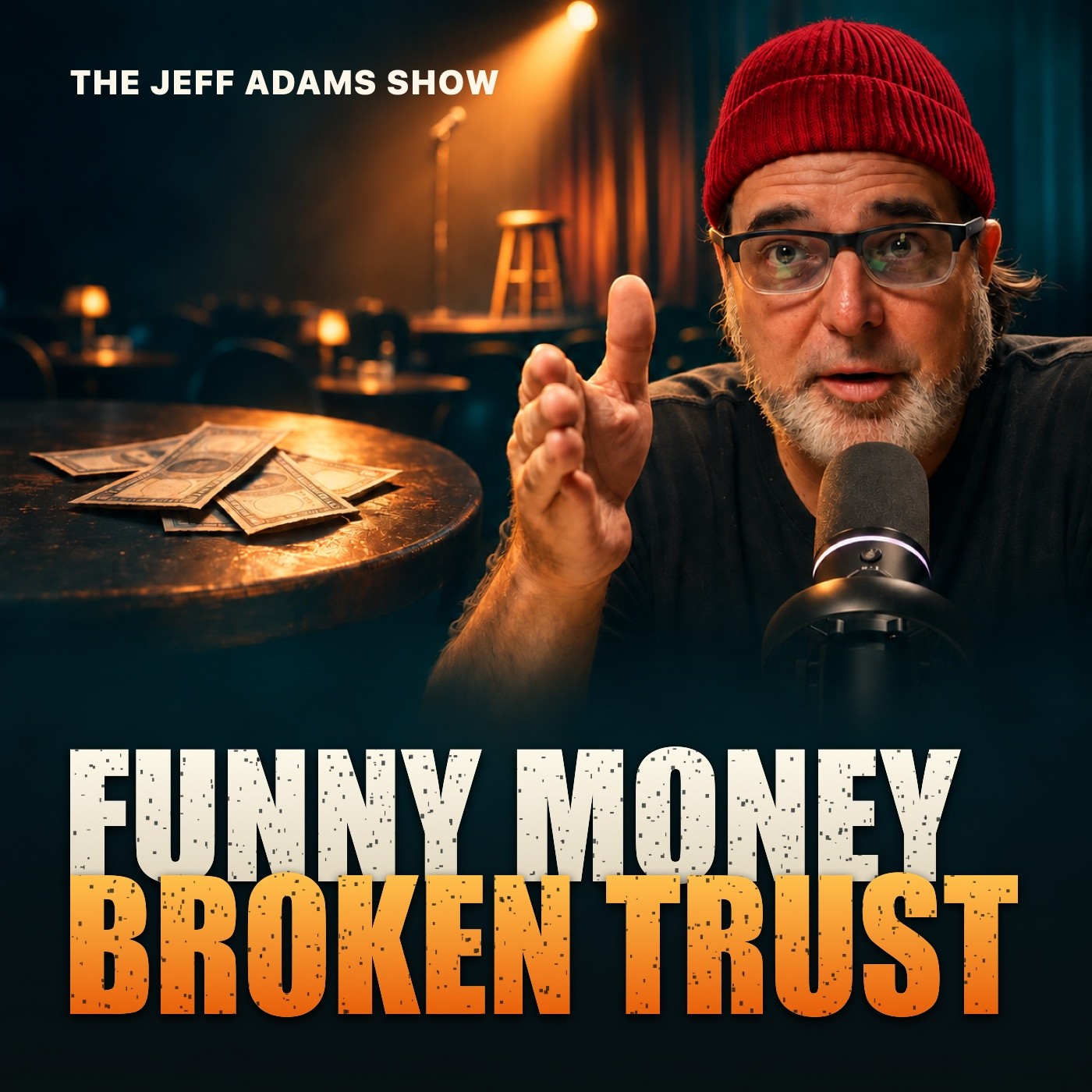
Dane Cook’s Funny Money and the Cost of Betrayal
November 28, 2026 · 9:34 · Hosted by Jeff Adams
About this episode
I put on Netflix’s Funny Money: The Dane Cook Story late one night and ended up thinking about a friendship I almost couldn’t forgive.On this episode of The Jeff Adams Show, I share my reaction to the documentary about Dane Cook and his half-brother Darryl McCauley. Then I tell the story it brought back from my years in artist management, when a close friend and business partner broke my trust. I talk about what it took to let go of that anger and what forgiveness looked like years later.Intro and outro music by ALTR, “Enter the Cowboy.”
Full transcript
Read the transcript
Welcome back to the Jeff Adams Show. It's late. I don't even know why I'm getting on the mic. I guess because it's the reason why I made this setup. So when I feel like it, I can get on the mic and I can just talk. Well, tonight was a special night. A, because... I typically don't have a Netflix membership. In fact, I haven't had one for years. Well, that's not true. A couple of months ago, I got it for a month to watch the show Tires with Shane Gillis and really enjoyed that. But outside of that, there was really nothing else that was any interest for me to stick around. Plus it's steep. You're talking about 1995. I don't know. I mean, at times, And place Netflix was everything. But yeah, but I caved. I caved the other night, a couple hours before the YouTube halftime game. I think it was Thanksgiving Eve. I purchased it, watched it live. Then I had regrets because it posted on YouTube. NFL posted the whole thing on YouTube for free. But then I'm like, dadgummit. So I started looking around, but I did see some things, watching some podcasts. I saw Dan Cook making rounds on the bigger podcast. I knew he had a documentary out called Funny Money, the Dan Cook story. And so I said, you know what, I'm going to watch it. From time to time, I see things that come out and I go, oh, wow, I want to watch this. There's another one, a Norm MacDonald documentary that I'm going to dive into here probably this weekend. Then there was a couple more. Primetime Preachers. I think it was about the 80s Preachers. Sorry about that. Netflix went off on me when I'm looking at the thumbnails. But yeah, Primetime Preachers. Going to watch that. So I'm going to try to make my money's worth out of this situation. But let's go back to the Dan Cook story. Dan Cook's story, out of a documentary... It kept me engaged. You kind of know what the story's about, obviously. I don't want to give too much away. I mean, you could look it up, but it was in the news. But the in-depth detail that they shared, you know, and how Dan Cook, even during the documentary, was finding out more information about what his brother did to him. It's basically, you know, his brother stole a lot of money from him. I don't want to do a spoiler, but, I mean, you can read that in the title of... the documentary on Netflix, but it's really good. I, you know, I give it a 7.5 because of the betrayal of it all that really happened. Um, I mean, you can choose to forgive or not forgive and you just feel a lot of tension there with the family, what, what it did, what betrayal does to a family. And I just, I, you know, for me, I kind of got sad. I was like, man, that's just devastating. You know, it's just devastating when people turn on you. There was years ago, I had, I would call him my best friend. And we were sitting on top of the world, man. We had sold my management company to this investor out of Atlanta, who I just heard, you know, about a month ago. You know, he's been passed away for several months, but we kind of lost contact because of, you know, how we all ended up at the end with the business. But we, you know, we started a record company and, you know, the whole, this new entity, um, basically acquired my management company, which I had a lot of successful Christian artists on. And, um, but I had, I brought my best friend. He was a radio promoter. We talk on the phone and he was like a brother to me. And I just remember things got tough. You know, I think we had probably a half a million dollars to really launch the label side of things to this investment in the acquisition of the management company. And it got stressful. You know, we made some hires, but we didn't have the cash flow to, you know, continue to pay these employees the way money was going out. So there was like no magic, you know, money tree in the backyard. So things got stressful. Like, you know, since we were like the executives, I was the active CEO. This friend I was talking about, you know, he was a CFO. So we had to sometimes not get paid, which sucks, especially, you know, a lot of the money that was really coming in was based off my blood, sweat and tears of all the groups that I managed and developed. You know, it would stink because I would get these checks come in for, you a tour for like merchandise and them doing an arena tour, one of the groups. And, you know, it was close to six figures. And you look at that and you go, dadgummit, this stinks. But anyway, it got tight. And this person, who I consider my good friend, betrayed a lot of its finest. He turned a couple of artists on us and was trying to get out, but he signed a non-compete where he couldn't take anybody with us. And then we got confronted by one of the artists who was a big time artist. And I was embarrassed. I never in my life wanted to chuck somebody off a balcony like I did that day. I felt so betrayed that why would he do that to me? So I had to excuse myself in the meeting and walk away. Needless to say, he walked away. He got out, but he didn't take the artist with him. Then I met up with the artist and they had no idea. They said, man, you know, we didn't know who you were because we always dealt with him. But now we know the situation, man, we're really sorry that we were aggressive with you and that we believed what he was saying. Because he pretty much said all these negative things that weren't true because he was under financial stress and he was locked into this deal. He couldn't go do anything pretty much in the music industry because he was locked in. So he left. I never heard from him again, but I chose to forgive. I was like, dad, you know, I just forgive. And then years after that, I think probably maybe five years, I just started texting with him and, um, we got right, we got right. And, you know, and that's what I was thinking. It's like, I could hold onto that betrayal of someone, you know, completely deceiving me, or I can choose to forgive. Now, granted, you know, I'm in the central Florida area. He's in Nashville, Tennessee. And I doubt I'd be hanging out with him anytime soon. But that's what I'm saying. The point is, why live your life in unforgiveness? Choose to forgive because you'll feel this heaviness come off of you. And when I did that, I was going through a lot of therapy at the time. And I was going through a divorce. And, you know, I missed my brother. And I reached out to him and told him what was going on. And we talked on the phone and I was happy for him. You know, he was married at the time, but, you know, he started having kids. He became a big time real estate agent in Nashville, you know, to the stars, you know. So he was doing well and I was happy, but I was happy to talk to him and have that closure. But watching this Dan Cook story makes me think about that. Watch it. It's worth a watch if you've got Netflix. I don't want to give it away, but the resolution with all that. It made me think about that moment like, man, because that was the closest thing, but this was his flesh and blood. Well, you know, Dan Cook's stepbrother. But you know what I'm saying. There's people in your life that you consider your brothers and your sisters, even though they're not blood. But it's a good documentary. And always remember, you know, there's times where Things don't make sense. People do you wrong. But don't carry that burden. Choose to forgive no matter how bad it is. It doesn't mean you have to hang out with them. It doesn't mean that you have to have a relationship with them. But you shouldn't carry that anymore. That you can live free and live your life and not live in the past and live with that burden anymore. There's no way to live. This is Jeff Adams and we'll talk soon.